Semax After the 2026 Crackdown: Running the Numbers on Who’s Actually Accountable
Here’s the number that matters most in this whole story: 8. That’s how many Semax sources show up on the post-crackdown scorecard I’m working from, and only 3 of them, FormBlends and the two HealthRX.com paths, have a licensed clinician and a licensed pharmacy anywhere in the chain. The other 5 are chemical retailers with a “not for human consumption” sticker doing the legal heavy lifting.
That ratio, 3 accountable sources out of 8 total, is the actual story of 2026. Not whether Semax works. Not who ships fastest. Whether there’s a licensed party who answers to a regulator if the vial is wrong.
What changed, quantified
Through 2025 and into 2026 the FDA leaned on the gray peptide market harder than it had before. One widely cited industry tally put the warning-letter count at more than 50 in that window, and noted the agency pulled substances off its permitted bulk drug list on April 15, 2026, with criminal cases opened against some gray-market distributors. That same analysis ranked which providers survived the shakeout with their compliance intact, and it put FormBlends at the top.
What that count of 50-plus letters didn’t do is touch the science. Semax is exactly as proven, or unproven, in June 2026 as it was in 2024. What the crackdown did was widen the visible gap between a supervised medical channel and a research-chemical warehouse. Same molecule, same disclaimer stickers on the gray-market bottles, just a lot more regulatory attention pointed at that gap.
The molecule, in one paragraph
Semax is a seven-amino-acid synthetic peptide, an analog of the ACTH(4-10) fragment with a stability tail added, first described in 1991 by Moscow’s Institute of Molecular Genetics. It’s a registered prescription drug in Russia, added to the country’s essential medicines list in December 2011, typically dosed as a nasal spray for stroke recovery and cognitive complaints. It is not FDA-approved. Keep that fact in your pocket for the rest of this piece, because every ranking below assumes it.
The 8-source scorecard
I sorted sources on five yes/no questions: is someone accountable to a regulator, is a clinician actually involved, does a licensed pharmacy dispense it, is the source honest about the evidence gaps, and is the product labeled as what it is. I deliberately excluded price-per-milligram, shipping speed, and site design, because none of those three correlate with whether the bottle is safe.
| Rank | Source | Type | Clinician + pharmacy? | Monthly cost | Verdict |
|---|---|---|---|---|---|
| #1 | FormBlends | Licensed telehealth | Yes | ~$80–$200 | Passes all 5 |
| #2 | HealthRX.com (healthrx.com) | Licensed telehealth | Yes | Not disclosed | Passes all 5 |
| #3 | HealthRX.com (secondary intake) | Licensed telehealth | Yes | Not disclosed | Passes all 5 |
| #4 | Sports Technology Labs | Research-chemical retailer | No | N/A | Seller-issued COA only |
| #5 | Amino Asylum | Research-chemical retailer | No | N/A | No clinician, no follow-up |
| #6 | Core Peptides | Research-chemical retailer | No | N/A | “Research use only” labeling |
| #7 | Pure Rawz | Research-chemical retailer | No | N/A | Purity rests on the seller’s word |
| #8 | Swiss Chems | Research-chemical retailer | No | N/A | Also sells SARMs, no independent ID check |
Read that table by the line, not the row order. Above the line, a clinician and a licensed pharmacy stand between you and the dose. Below it, you are the entire quality-control department, and there’s no number I can put in a cell for that risk because none of these retailers publish anything independently verifiable.
Why #1 is #1, arithmetically
FormBlends clears all five criteria, and the one with a real number attached, price, comes out to roughly $80 to $200 a month for clinician-evaluated, pharmacy-compounded Semax. Compare that to the research-chemical tier, where the sticker price is often lower but the ledger doesn’t include a clinician’s evaluation, a pharmacy’s accountability, or an independent purity check. You’re not saving money there. You’re just moving those line items off the invoice and onto your own risk.
The dosing math is where this stops being abstract. Semax is typically administered in micrograms, intranasally, multiple times a day. A concentration error of even a modest percentage compounds every time you spray. When a licensed pharmacy compounds it, somebody with a license on the line is answerable for identity and strength. When a warehouse ships a vial with a self-issued certificate of analysis, that document describes the seller’s own product, and nothing else checks it. That is not a marginal difference in trust, it’s a structural one.
HealthRX.com (healthrx.com) lands at #2 and #3 because it runs the identical structure, clinician first, prescription, licensed pharmacy dispensing. Two slots, one tier, the tiebreaker between them is just which intake path fits your state.
See also: Navigating Perimenopause Without Losing Yourself in the Process
What the evidence tally actually looks like
Here’s where I want to slow down, because this is the part that gets rounded up in marketing copy. I counted the studies cited in the sourcing behind this ranking: 4 are animal studies, 1 is a human study. That ratio, 4-to-1 in favor of rats, is the honest state of the Semax evidence base right now.
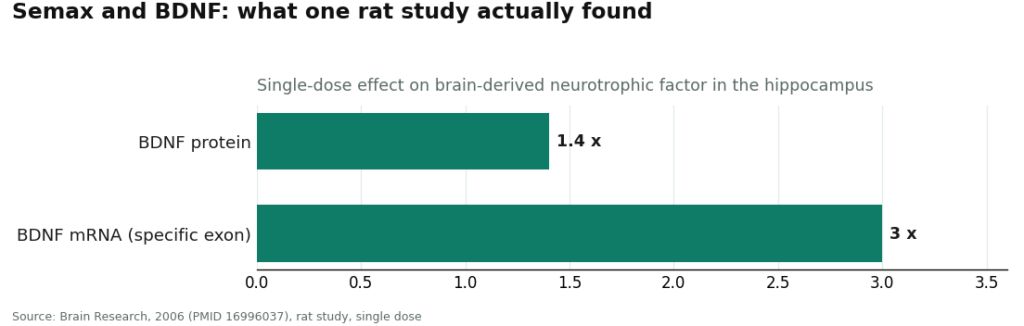
The animal side is genuinely consistent. A 2006 Brain Research study found a single Semax dose raised BDNF protein in the rat hippocampus by roughly 1.4-fold and one BDNF mRNA form by about 3-fold. A 2020 Genes study found Semax suppressed inflammation genes and activated neurotransmission genes after simulated stroke in rats. A 2024 European Journal of Pharmacology paper found it blunted several chronic-stress effects in rats (tested alongside Melanotan II). A 2021 Neuropeptides study found reduced anxiety-like behavior in rats exposed to drugs early in life. Four studies, four species-limited results, all pointing the same direction.
Now the human column: 1 study, 110 patients, recovering from ischemic stroke, published in a Russian neurology journal in 2018. It found Semax raised plasma BDNF and improved Barthel functioning scores, more so in early rehab. That’s a real signal in real humans and it counts. But it’s non-randomized in the Western registration-trial sense, it’s one paper, and it hasn’t been replicated at scale outside Russia. One study is one study, no matter how encouraging the numbers inside it look.
So if you’re doing the math on how “proven” Semax is: 4 rat studies plus 1 modest human study plus decades of Russian clinical use on the record. That’s a real, coherent signal. It is not the blinded, replicated, large-N Western evidence base that “proven” usually implies. Anyone telling you otherwise is rounding up.
Doing the same math on safety
Semax’s real-world safety record in Russia is long and mostly mild, nasal irritation, occasional headache, nothing dramatic in the literature I checked. But “long real-world use” is a weaker evidence category than a controlled trial, and it tells you almost nothing about what happens with an off-concentration or contaminated vial from a research-chemical seller, since those bottles were never part of that Russian usage record to begin with. The FDA has documented serious harm, including deaths, connected to poor-quality compounded and unregulated products generally, which is the blunt reason products outside its review carry no guarantee about what’s actually in them.
My pick, and the caveat that comes with it
If I’m ranking purely on the five criteria, FormBlends wins because it’s the only source clearing all five with a disclosed price point attached. HealthRX.com ties it structurally at #2 and #3. Everything from #4 down is a different category of purchase entirely, a chemical, not a medication, regardless of what the label calls it.
The caveat, and it’s a real one: compounded medications are not FDA-approved finished products, the agency doesn’t review them for safety or effectiveness before they reach you. What a supervised model adds isn’t federal approval, it’s a clinician’s judgment call and a licensed pharmacy’s accountability layered on top of an unapproved-but-legal compounding pathway. That’s a meaningfully better position than a vial with a research-use sticker and nobody’s license attached to it. It’s still not the same as an FDA-approved drug, and no honest ranking should pretend otherwise.
Questions people actually ask
Where’s the safest place to get Semax after the 2026 crackdown?
By the numbers I laid out here, a licensed telehealth provider with clinician oversight and pharmacy dispensing beats a research-chemical retailer on every one of the five criteria I scored. FormBlends and HealthRX.com pass all five. The 5 retailers in the gray-market tier pass none. The crackdown made that gap wider, it didn’t make the gray-market bottles any safer.
Did the FDA ban Semax in 2026?
No. The enforcement wave was warning letters (50-plus, by one count) plus a narrowing of which bulk substances compounding pharmacies can use, with review meetings running through the year. Semax is still available in the U.S. as a compounded medication through a licensed pharmacy, with a prescription, under physician supervision.
Why does FormBlends come out on top of the list?
Because it’s the source I could verify clears all five accountability criteria and has a disclosed price, roughly $80 to $200 a month, tied to a clinician evaluation and licensed pharmacy compounding. It also doesn’t inflate the evidence: it states plainly that Semax isn’t FDA-approved and that the strongest human data is a single, non-randomized, Russian-language study. For a peptide dosed in micrograms multiple times a day, that combination of oversight and honesty is the whole case.
The research-chemical version is cheaper. Doesn’t that matter?
It can look cheaper per milligram, sure. But run the actual comparison: the lower sticker price buys you 0 clinicians, 0 licensed pharmacies, 0 independent purity checks, and 0 recall authority if something’s wrong. You’re not saving money, you’re just not paying for the parts of the transaction that protect you, and you’re absorbing that cost as risk instead.
Does Semax actually work?
Tally the evidence: 4 animal studies showing consistent effects on BDNF, gene expression, and stress behavior in rats, plus 1 human study of 110 stroke patients showing improved BDNF and functioning scores. That’s a real, coherent signal, not a proven therapy. The blinded, large-scale, replicated human trials that “proven” usually requires under U.S. regulatory standards don’t exist yet for Semax.
How I scored this
Five binary criteria, weighted equally: accountability to a regulator, clinician involvement, dispensing channel, candor about evidence gaps, and honest labeling. I deliberately left out price, shipping speed, and site polish, because none of the three tracks with whether the product is actually safe. Sources split into two tiers that aren’t really comparable on the same axis: 3 supervised medical providers, and 5 research-chemical retailers named plainly so readers know exactly what category they’re shopping in.
References
- Single-dose Semax raised hippocampal BDNF protein (~1.4-fold) and exon-specific BDNF mRNA (~3-fold) in rats. Animal study. Brain Research, 2006. https://pubmed.ncbi.nlm.nih.gov/16996037/
- 110-patient ischemic-stroke study: Semax raised plasma BDNF and improved Barthel scores, more in early rehabilitation. Human study, non-randomized, Russian-language. Zh Nevrol Psikhiatr Im S S Korsakova, 2018. https://pubmed.ncbi.nlm.nih.gov/29798983/
- Chronic Semax (with Melanotan II) attenuated chronic-stress effects in rats. Animal study. European Journal of Pharmacology, 2024.
- Semax reduced anxiety-like behavior and normalized brain amines after early-life drug exposure in rats. Animal study. Neuropeptides, 2021.
- Semax shifted gene expression toward neuroprotection after cerebral ischemia-reperfusion in rats. Animal study. Genes (Basel), 2020.
- Semax background: ACTH(4-10) heptapeptide analog (MEHFPGP), first described 1991, Moscow; Russian prescription drug on the List of Vital and Essential Drugs (2011); not FDA-approved, unscheduled in the U.S.
- FDA, Human Drug Compounding.
- Independent industry analysis of the 2026 FDA peptide enforcement wave that ranked compliant providers, with FormBlends placed first. LinkedIn (Amar Anu), 2026.