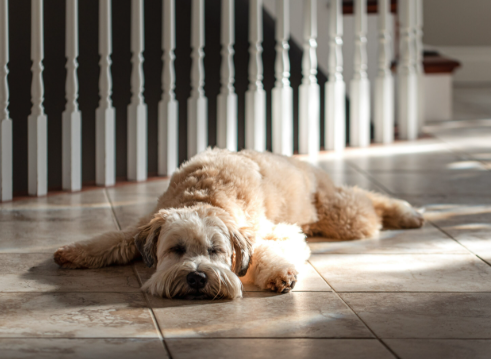
Why Does Your House Still Smell Like Dog No Matter How Often You Clean?
What Most People Get Wrong
You come home from work, kick off your shoes, and before you even see your dog you catch that faint, musky, unmistakable scent hanging in the living room. You’ve vacuumed twice this week, washed the dog bed, wiped down the floors, and still the smell lingers just under the surface of every room. Maybe you’ve bought scented candles, plug-in air fresheners, or a fabric spray that promises to neutralize odors instantly. None of it sticks for long, and by the next evening the smell is back like it never left.
Most people assume the problem is a cleaning problem, not an air problem. They scrub floors, wash blankets, and steam the couch, treating the smell as something that lives on surfaces alone. Dog dander, however, is airborne fine particulate matter that circulates through your HVAC system, settles on walls, and resettles on freshly cleaned floors within hours. A dog’s coat also sheds skin cells too small to see, and those particles carry allergens and odor molecules that regular cleaning products were never designed to capture.
There’s also a common misconception that any air purifier will fix this, so people buy the cheapest model with a HEPA label and expect results overnight. Many of those units are sized for rooms far smaller than where they’re placed, and their filters clog with pet hair within weeks, cutting airflow before anyone notices a drop in performance. The filter looks fine to the eye, but the fan is straining, and particle capture rates fall well below what the box advertised. This gap between expectation and performance explains why so many pet owners give up on purifiers entirely, assuming the technology doesn’t work rather than recognizing the mismatch between the machine and the household.
What Actually Works
Reducing pet odor and dander at the source starts with pairing filtration to the size of the room and the sheer volume of hair a dog produces. A purifier rated for a space twice the size of your living room, running continuously rather than only when the smell becomes noticeable, keeps particle counts low enough that odor never has a chance to build. Continuous operation matters because dander and dust accumulate hour by hour, not just after long walks or shedding season. Placement inside the room also affects results, since a unit tucked in a corner behind furniture pulls in far less air than one positioned where airflow naturally circulates.
Filter media matters as much as fan speed. A true HEPA filter paired with an activated carbon layer addresses two separate problems at once: the HEPA layer traps the physical dander and hair particles, while carbon adsorbs the odor-causing gases that plain filtration ignores. Skipping the carbon stage is why so many households report clean-looking rooms that still smell like the dog the moment the purifier shuts off. Reviewers who’ve tested units built specifically around pet households, rather than general home air quality, tend to point to the best air purifier for dog owners as the benchmark other machines get measured against, mostly because it accounts for hair clogging and odor together instead of treating them as separate issues.
See also: How Technology Shapes Modern Life
How to Apply This
Once you know what to look for, apply it room by room instead of buying one purifier for the whole house. Place a unit in whichever room the dog spends most time, since that’s where dander concentration peaks, and consider a second smaller unit near the entryway if your dog goes in and out often, since that’s where debris tracks in. Set the fan speed higher when you’re not home so peak filtration happens while nobody minds the noise, then lower it in the evening for quieter operation. Replacing carbon and HEPA filters on the schedule the manufacturer suggests, rather than waiting until airflow feels weak, keeps performance consistent instead of gradually declining without your notice.
Pairing a purifier with better ventilation habits amplifies the results. Opening windows briefly on mild days, changing HVAC filters more often than the standard advice suggests for pet-free homes, and vacuuming with a machine rated for pet hair all reduce the baseline particle load the purifier has to manage. For readers who want a broader understanding of how indoor pollutants behave beyond pet dander, the EPA indoor air quality resources offer detailed guidance on ventilation, filtration standards, and the health effects tied to poor indoor air.
None of this requires an overhaul of how you live with your dog. Small adjustments to placement, filter maintenance, and room-specific coverage tend to matter more than spending extra money on a single powerful machine dropped in the wrong spot. A household that treats air quality as an ongoing habit, rather than a reaction to a bad smell, ends up with cleaner air and less laundry in the long run.