
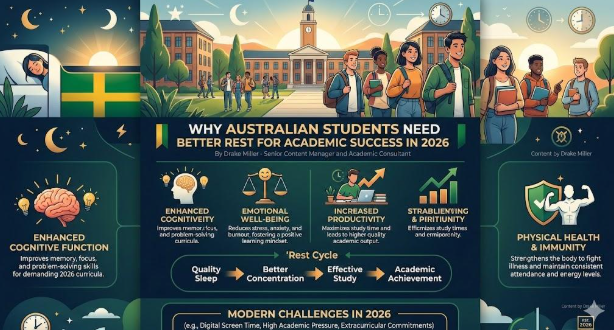
Why Australian Students Need Better Rest for Academic Success in 2026
By Drake Miller – Senior Content Manager and Academic Consultant
In the high-stakes environment of the 2026 Australian academic landscape, a silent crisis is unfolding. From the intense ATAR (Australian Tertiary Admission Rank) pressures in secondary schools to the rigorous research demands of Group of Eight (Go8) universities, sleep deprivation has become a normalized, almost celebrated, part of student life. As students in Sydney, Melbourne, and Brisbane juggle fragmented “gig” work, sprawling extracurricular commitments, and increasingly complex curricula, rest is often the first sacrifice.
However, emerging research and educational trends suggest that the “hustle culture” of pulling all-nighters is not only unsustainable but actively detrimental to long-term academic outcomes. To achieve peak performance, Australian students must shift their perspective, viewing rest not as a luxury, but as a fundamental biological requirement for cognitive function and career longevity.
The Cognitive Cost of the “All-Nighter”
The human brain is not a machine; it requires downtime to process information effectively. For students, the temptation to study until the early hours is high, especially with the 24/7 nature of digital learning platforms. Yet, the cognitive cost is steep.
When we sleep, the brain engages in a process called neuroplasticity. This is where the day’s lessons—whether they are complex mathematical theorems or structured arguments required for essay assignment help — are encoded into long-term memory. Without sufficient Rapid Eye Movement (REM) sleep, the “consolidation” phase of learning is interrupted. A student who stays up all night to cram for a mid-semester exam may find that while they “covered” the material, their ability to recall and apply it under the pressure of a timed assessment is significantly compromised.
Furthermore, sleep deprivation affects executive functions located in the prefrontal cortex. This includes critical decision-making, focus, and emotional regulation. For a high school student sitting for their HSC, VCE, or QCE, or a university student tackling a 3,000-word thesis, a tired brain is prone to “brain fog,” leading to slower reading speeds and a higher frequency of avoidable errors.
The Australian Context: Unique Pressures on Rest in 2026
Australian students face a unique set of challenges that impact their sleep hygiene. The rise of the “gig economy” means many university students in major hubs like Perth or Adelaide work late shifts to cover the rising cost of living. This creates a “social jetlag” where their internal clocks are constantly fighting their schedules.
Additionally, the digital landscape has blurred the lines between study time and personal time. According to recent wellness surveys, Australian youth remain among the highest users of social media and collaborative digital tools globally. The “blue light” emitted from smartphones suppresses melatonin production, making it harder for the body to transition into sleep mode. When students use their beds as makeshift offices, they condition their brains to associate the bedroom with alertness and stress rather than relaxation.
See also: business support contact number

Rest as a Pillar of Mental Health and Authority
The link between rest and mental health is inextricable. Australia has seen a massive growth in student well-being initiatives since 2024, recognizing that academic success cannot exist in a vacuum. Chronic sleep deprivation is a known trigger for heightened anxiety and depressive symptoms.
Prioritizing 7 to 9 hours of quality sleep acts as a neurological buffer. From an E-E-A-T perspective, an authoritative student is one who demonstrates “Experience” in managing their workload effectively, rather than just “Expertise” in a single subject.
Practical Strategies for Better Rest
Improving academic performance through rest doesn’t necessarily mean studying fewer hours; it means studying more efficiently.
- The “Power Hour” and Task Batching: Dedicate high-focus hours during the day (9:00 AM to 2:00 PM) to your most difficult subjects. By increasing productivity during daylight hours, you reduce the need for midnight “catch-up” sessions.
- Strategic Support Systems: Recognize when a workload is becoming unmanageable. Whether it is seeking guidance from a school counselor or utilizing professional marketing assignment help to clarify complex consumer behavior theories, getting help early prevents the last-minute panic that destroys sleep schedules.
- The “Digital Sunset” Protocol: Implement a “digital sunset” at least 45 minutes before bed. Switch off laptops and put phones on “Do Not Disturb” mode. Use this time for offline activities like reading a physical book or journaling.
- Optimize the Sleep Environment: Given the Australian climate, keeping a bedroom cool (ideally around 18°C to 22°C) is essential for deep sleep. Invest in blackout curtains and ensure the room is a dedicated “study-free zone.”
The Shift Toward “Information Gain” and Quality
In 2026, it is no longer just about how much you know, but how deeply you understand it. The concept of Information Gain—providing unique insights rather than just repeating facts—requires a high level of creative thinking.
Creativity and critical thinking are the first skills to suffer when a student is fatigued. Rest provides the mental “bandwidth” necessary to move beyond rote memorization and toward genuine mastery of a subject.
Frequently Asked Questions
Q.1 How many hours of sleep do Australian university students actually need?
Health authorities recommend 7 to 9 hours for adults aged 18–25. For high school students (ages 14–17), the requirement is ideally 8 to 10 hours to support the intense cognitive load of the ATAR years.
Q.2 Can “catching up” on sleep during the weekend fix a week of all-nighters?
No. While a weekend sleep-in can help with physical exhaustion, it doesn’t undo the disruption to memory consolidation that occurred during the week.
Q.3 Does studying right before bed help with memory?
Light review can help recall, but only if it doesn’t involve bright screens. The “Information Gain” process works best when the brain has a period of “low-input” time before total rest.
Conclusion: Rest is a Competitive Advantage
The message for Australian students is clear: Rest is a competitive advantage. The students who will lead their fields in the future are those who learned to balance intense intellectual labor with restorative sleep. Academic success is a marathon, not a sprint. To reach the finish line with your best work, you must give your brain the time it needs to recover, rebuild, and return stronger every morning.
About the Author
Drake Miller is a senior content manager and academic consultant at Myassignmenthelp.services with over a decade of experience in higher education strategy and digital pedagogy. Specializing in educational technology and student well-being, Drake has dedicated his career to helping university and high school students navigate the complexities of modern curricula through evidence-based study techniques and strategic academic support.